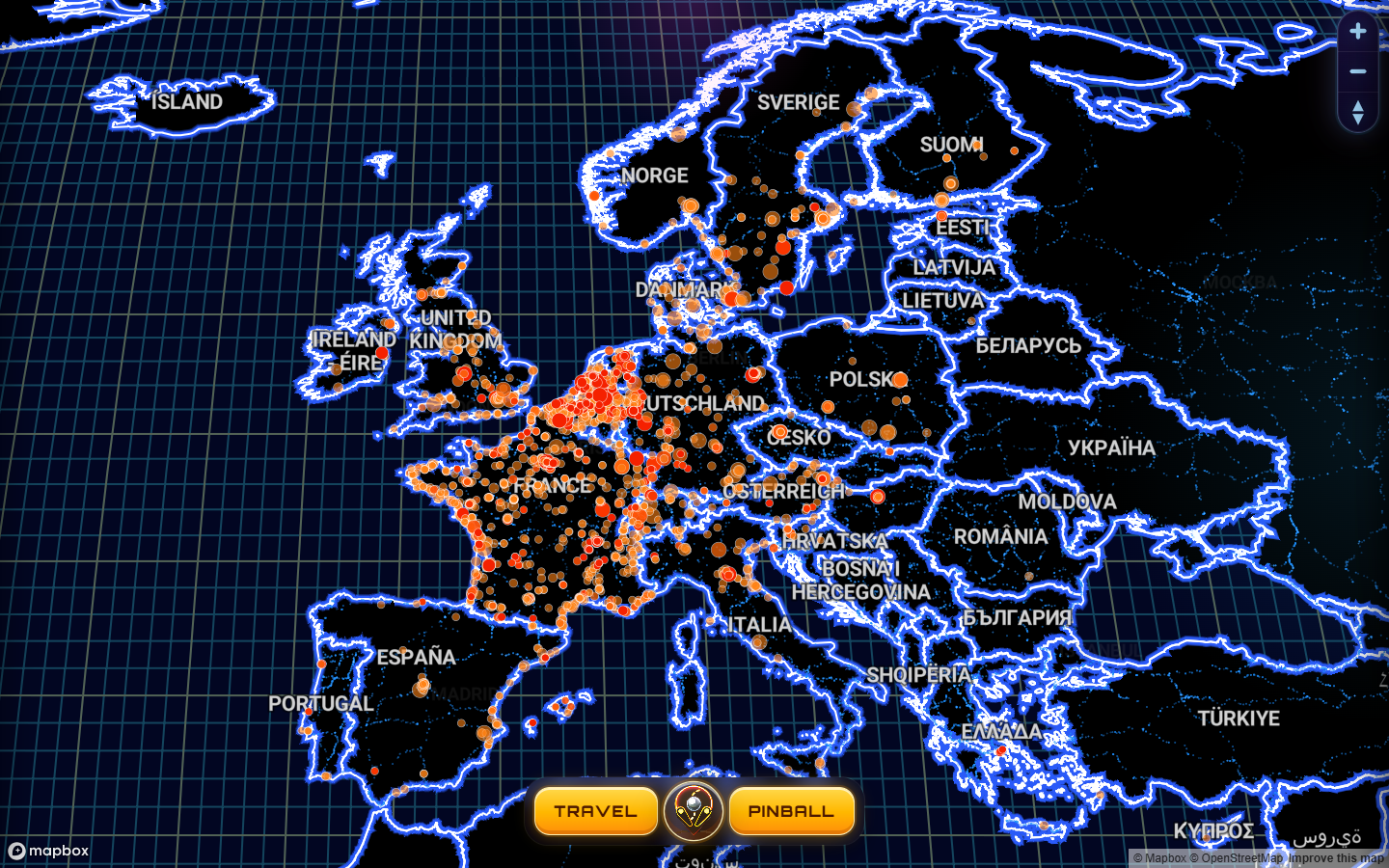
A friend and I are both big pinball fans. We wanted a simple way to see every machine around us, together with the bars, arcades and other venues where we could play.
We found Find a Pinball, which already had a rich European database. At the time, however, browsing it by country or city did not give us the geographical experience we wanted. We wanted to start from our actual position and explore the machines around it on a map.
The project also became an experiment: how quickly could two people build a fairly complex product when AI handled much of the implementation work? The first functional version took us almost two intensive days. A map designed to make the density of machines immediately visible.
Three ways to find the next game
Around me starts from your position and shows the nearby venues and the machines available at each one.
Travel turns a journey from A to B into a pinball road trip. It gathers the venues around the route and estimates the detour required to stop for a game along the way.
Pinball lets you search for a specific model across the database. An occurrence indicator also gives an idea of its rarity: common machines appear in many venues, while the rarest may only have one or two known locations in Europe.
Building with AI, designing as a pair
We spent the beginning of the project side by side, discussing features, interactions and technical feasibility while using AI to prototype each idea quickly. This left us more time to decide how the product should behave instead of spending it writing every implementation detail by hand.
As the application became more mature, I focused on the functional details, loading performance, hosting and domain setup. My friend concentrated more on the visual identity of the map: a bright neon world inspired by the lights and energy of a pinball machine.
Mapbox gave us the mapping, routing and styling tools needed to bring both sides together.
Data was the real challenge
Displaying a map was relatively straightforward. Building and maintaining our own consistent database was not.
We created an importer to collect the available locations, then had to normalize venues, addresses and machine records into a structure we could use. Because the source did not accept requests directly from our server, the ingestion pipeline also required an intermediary request layer.
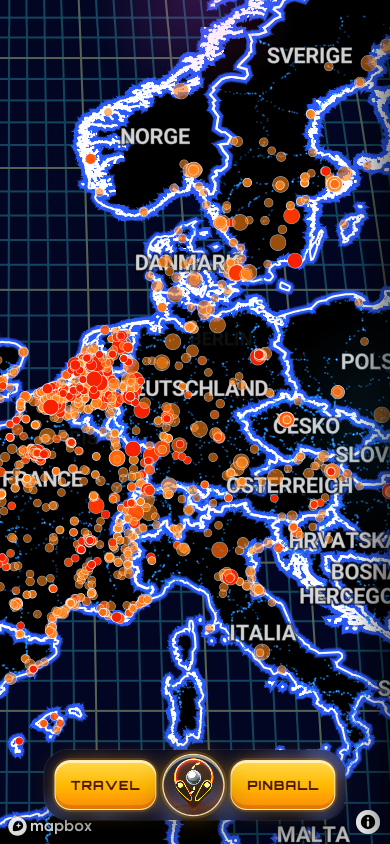
The first version of the map was slow when loading thousands of locations. We changed the way data and markers were loaded so the interface could appear much faster. Responsive UX required another round of work: interactions that feel natural on a large desktop map need a very different layout on a phone. The mobile map keeps the two main actions within thumb reach.
What comes next?
Pinned-ball is live and functional, and its importer is still keeping the database supplied.
The next useful step would be to send players to the right contribution platform when they notice an outdated or missing location. We would also like to combine authorized data from other community projects such as Pinball Map, cross-check their freshness and enrich results with useful community notes.
Further ahead, an intelligent agent could help verify uncertain records directly with venues. The long-term goal is simple: make the map as complete and current as possible, while keeping it effortless to use.
If you have any suggestions, contact me via What`s App!